
Lesson 4 – الدَّرْسُ الرَّابِعُ
The Prepositions - حُرُوفُ الْجَرِّ
- In this part, we will learn about some of the Arabic prepositions, In-Shā'-Allâh (God willing). The Arabic preposition is an important topic that help you learn Arabic through our free Arabic language course.
- A preposition is a word which shows the relation of one word to another. For example, "....the key is in the car...." or "....the book is on the table....".
Episode 10 - Lesson 4 A
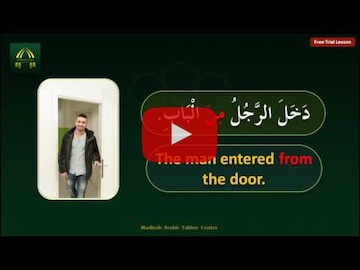
In this series we will learn Arabic language by examples
- Some of the most common prepositions are:
- We will also learn about the rule applied for the use of prepositions in Arabic Language. The following rules are applied for the use of prepositions:
- A preposition (حَرْفُ الْجَرِّ- called /harf ul ĵarr/ in Arabic) is a single letter or a word which connects two nouns, or a verb and a noun to form a sentence. As above this is generally showing the position of one word to another. It always precedes a word and never follows the word.
- A preposition always comes before a noun and it does not come before a verb.
- The noun following a preposition is changed from nominative case to genitive case. This means that the last letter of the word will be changed from a /đammah/ or /đammatain/ to a /kasrah/ or /kasratain/.
- The noun following a preposition is called /Maĵrūr/ مَجْرُورٌ which means the preposition has caused a change in its case (from nominative to genitive case) as mentioned in the previous rule.
- Let’s look at an example (please read from right to left):
| Phrase (preposition before word) | Word without preposition | Preposition |
|
| Arabic | |||
| In the house | The house | In | English |
- When a preposition precedes an indefinite noun (e.g. "a house"), the noun is affected in the same way. As we learnt earlier, a noun which is indefinite takes two /đammahs/ (đammatain) and is also in the nominative case. The two /đammahs/ change to two /kasrahs/ (kasratain) when a preposition comes before the noun . Let us examine the example as above with relation to an indefinite noun:
| Phrase (preposition before word) | Word without preposition | Preposition |
|
| Arabic | |||
| In a house | A house | In | English |
Some more examples can be found below.
| Picture: | Phrase with preposition | Phrase without preposition |
|
| ||
| In a kitchen | A Kitchen | |
|
| ||
| To a mosque | A Mosque | |
|
| ||
| From a house | A house | |
|
| ||
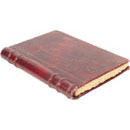
| On a book | A book |
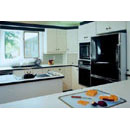
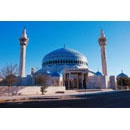
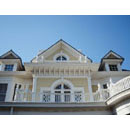
- In this part of the lesson we will study some practical sentences using the prepositions and understand the rules relating to prepositions.
- In Arabic language when it is required to make a noun definite, الْ is added to that noun. You have also learnt in the previous lessons about the solar and the lunar letters.
- However when a preposition comes before a definite word the /alif/ - i.e. "a" sound - of الْ is dropped and hence not pronounced. Please note that the "a" of "al" is pronounced only when it is not preceded by any other word but when "al" is preceded by any word the letter "a" is dropped and hence not pronounced.
- So we will read the sentence as /Fil Baiti/ and not /Fee Al baiti/ but this rule is applicable in reading only and not while writing the sentence - i.e. the /alif/ will still be written but not pronounced in spoken language.
Please click on the words to hear speech, i.e. how the words should be pronounced.
| Picture | Translation | Transliteration | Arabic |
|
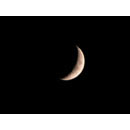
| The moon is in the sky. | /Alhilālu fis Samā’-i/ | |
|
| To the door | /Ilal bābi/ | |
|
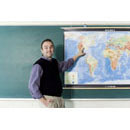
| From the teacher | /Minal muddarrisi/ | |
|
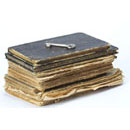
| The key is on the book | /Almiftāħu ξalal kitābi/ |

- We shall continue with some more practical sentences, please make an effort to memorise the words and common sentence structures.
Please click on the words to hear speech.
| Picture | Translation | Arabic |
|
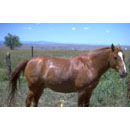
| A horse in the farm | |
|
| The man is from India. | |
|
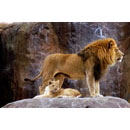
| The lion is on a rock. | |
|
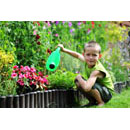
| The boy is in the garden. |

- In the next part of the lesson we will go over some interrogative expressions (i.e. expressions used for asking questions) covering the areas you have learned in this lesson In-Shā'-Allâh (God willing).